
Service Catalogue Excellence: What Good Looks Like
In any services business - whether you operate in IT, cloud, digital, or professional services - the strength of your service catalogue can be the difference between scalable, profitable growth and a messy, margin-eroding sprawl. Yet, too often, businesses fall into the trap of overextending themselves with ill-defined services, or failing to regularly review and refine their offering.
So what does good look like when it comes to your service catalogue?

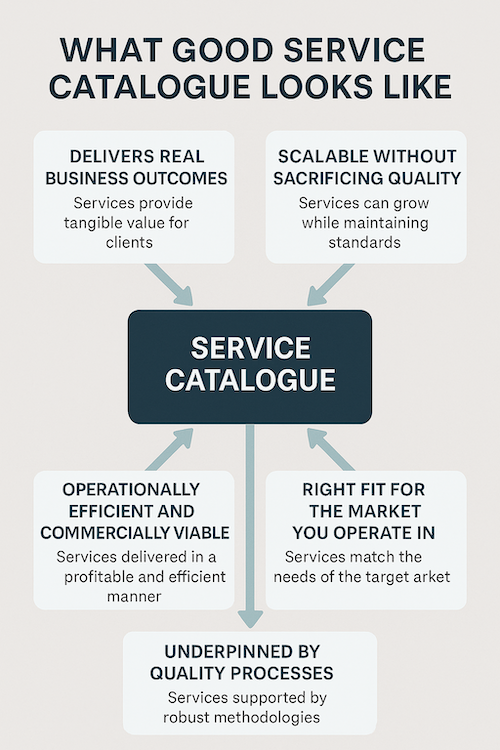
Services That Deliver Real Business Outcomes
A high-performing service catalogue is rooted in the needs of your clients. It moves beyond technical outputs or activity-based offerings and is framed around the business outcomes your clients are trying to achieve.
Whether it's driving efficiency, improving security posture, enabling transformation, or reducing risk - your services should make it easy for clients to see the value you're delivering in their language, not yours.
Ask yourself:
Does every service have a clear client-facing value proposition?
Can your team articulate the business outcomes each service supports?
Do your services help your clients solve real, urgent problems?
Operationally Efficient and Commercially Viable
It's not enough for a service to sound valuable - it must also be able to be delivered efficiently, consistently, and profitably. This is where many businesses stumble, especially when services are designed in isolation from delivery, commercial, and operational teams.
Good services:
Have clearly defined scopes, boundaries, and standardised deliverables.
Are underpinned by robust delivery processes, tools, and templates.
Are priced in a way that reflects the effort, risk, and value, ensuring sustainable margins.
Have clear handoffs between functions, minimising friction and rework.
Scalable Without Sacrificing Quality
As your business grows, your services need to scale with you. This means they should be designed from day one with scalability in mind - both from a delivery and a quality perspective.
Key considerations include:
Repeatable, documented processes that don't rely on heroics or individual expertise.
Quality assurance baked into the service lifecycle, from scoping to delivery to close-out.
Automation and tooling leveraged where appropriate to remove manual effort and reduce variability.
A clear understanding of the service's limits - when does it stop being viable, and when might custom approaches be required?
Right Fit for the Market You Operate In
One of the most overlooked aspects of service design is ensuring your services match the needs, budgets, and expectations of your target market.
High-end, bespoke services might be perfect for enterprise clients but are overkill (and unprofitable) in the mid-market. Conversely, commoditised services that play well in the SMB space may struggle to gain traction in complex, regulated environments.
Regularly ask:
Is your service catalogue aligned to the needs and buying behaviours of your target clients?
Are you clear on where you win - and where you don't?
Do you have a process to retire or refine services that are no longer fit for market?
Underpinned by Quality Processes
No matter how well-designed your services are, they will falter without disciplined, well-governed processes underpinning them. This includes:
Service design and review processes.
Delivery governance and quality checks.
Feedback loops from clients and internal teams to drive continuous improvement.
Clear ownership and accountability for each service.
Final Word: Service Excellence Is a Discipline
A strong service catalogue is not a set-and-forget exercise. It's a living, breathing part of your business that requires regular attention, refinement, and alignment to your strategy and market needs.
Businesses that get this right are able to scale without compromising quality, protect and grow margins, and, most importantly, deliver genuine value to their clients.
Those that don't? They drown in complexity, suffer from client dissatisfaction, and leave money on the table.